
Axial Flow vs Globe Control Valves for Gas Transmission Stations
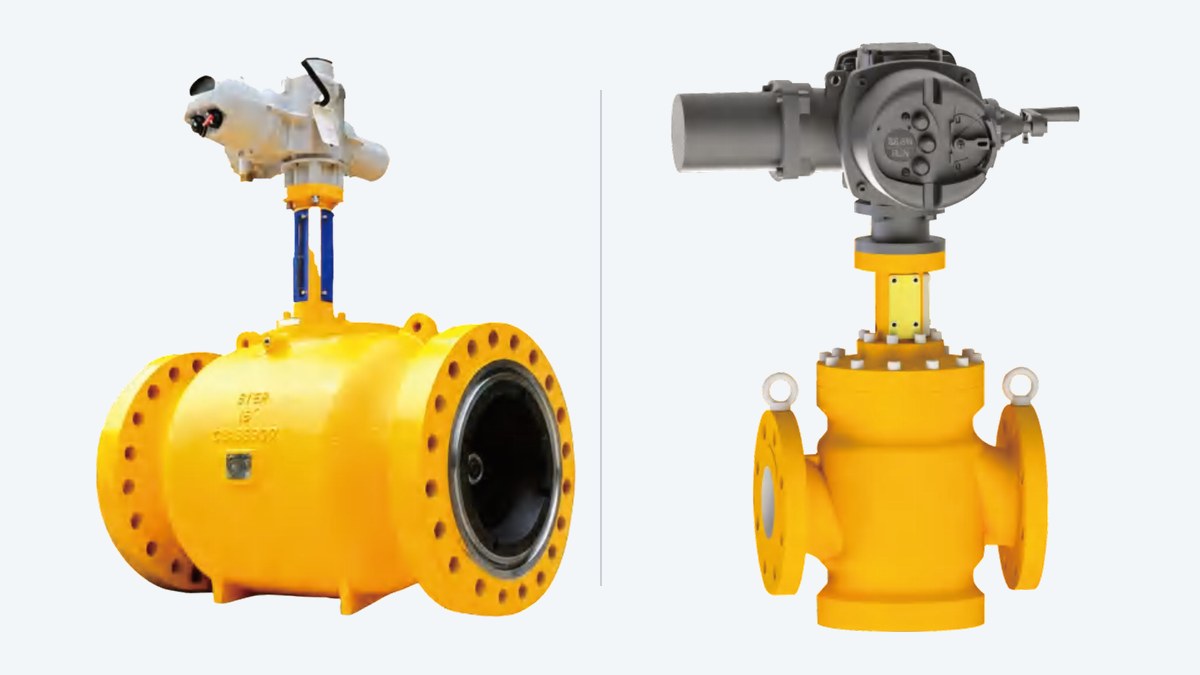
An axial flow control valve keeps gas on the pipe axis and throttles it in an annulus around a streamlined inner body; a globe control valve turns the gas through a seat and back out again. For natural gas transmission stations, the practical split is size and pressure class first, then noise, duty speed and maintenance access. In our 2025 catalogue the FCV-S800 globe control valve covers NPS 1”–12” up to Class600, while the FCV-A800 axial flow control valve covers NPS 2”–40” up to Class2500.
How each valve moves the gas
A control valve in a gas station does one job: it takes pressure out of the gas in a controlled way, so that flow or downstream pressure follows a set point. The two designs do this with very different flow paths.
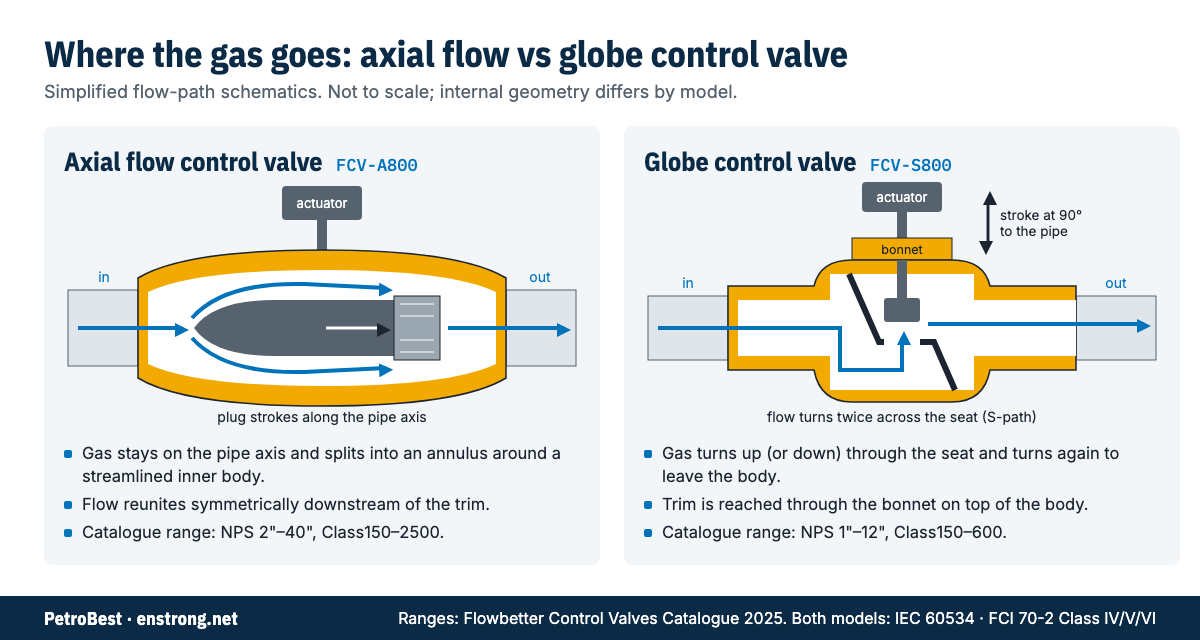
Globe control valve. Gas enters the body, turns up (or down) through an opening in the internal web, passes the seat where the plug throttles it, then turns again to leave through the outlet. The plug is moved by a stem that runs at 90 degrees to the pipe. The trim — plug, seat and, on cage-guided designs, the cage — sits under a bonnet on top of the body.
Axial flow control valve. Gas stays on the pipe centreline. It splits around a streamlined inner body into an annular passage, passes through the trim near the outlet end, and rejoins symmetrically downstream. The closure member strokes along the pipe axis. The actuator still sits on top of the valve, and the drive inside the body converts its motion into an axial stroke.
Pressure drop, noise and what the flow path changes
A control valve is meant to drop pressure, so “low pressure drop” is not the goal in itself. What matters is where the energy goes and how evenly the flow leaves the valve.
Direction changes. A globe body turns the gas twice. Each turn adds losses that are not controlled by the trim, and they limit how much flow a given body size can pass. An axial body keeps the flow straight, so more of the pressure drop happens at the trim, where it is intended.
Outlet flow pattern. In a globe valve the gas leaves the seat region and hits the body wall before turning into the outlet. In an axial valve the jets leave the trim in a ring and rejoin on the centreline. A symmetric outlet stream is easier on the downstream pipe and on nearby instruments.
Aerodynamic noise. At high pressure ratios, gas accelerates through the trim, and noise comes from the turbulent mixing of the jets downstream. Most of it travels down the pipe and radiates from the pipe wall. The main tools against it are the same in both designs: split the flow into many small jets (multi-hole cages), take the drop in stages, and keep outlet velocity down. IEC 60534-8-3 gives the prediction method, and IEC 60534-2-1 gives the sizing equations — both are listed on our standards page. Ask for a noise prediction at your real operating points, not at one design case.
Control characteristic. Both the FCV-A800 and FCV-S800 are listed with equal-percentage, linear or other characteristics, intrinsic error up to 1%, and hysteresis and dead band below 1% (Flowbetter catalogue 2025). The body type does not fix the characteristic; the trim does.
Axial vs globe: catalogue figures side by side
The table below uses only the figures printed in the Flowbetter Control Valves Catalogue 2025. Final data is confirmed per project.
| Item | FCV-A800 axial flow control valve | FCV-S800 globe control valve | ASV-A500 axial flow anti-surge valve |
|---|---|---|---|
| Flow path | In-line, annular around an inner body | S-path through the seat | In-line, annular around an inner body |
| Nominal size | NPS 2”–40” | NPS 1”–12” | NPS 4”–32” |
| Pressure class | Class150–2500 | Class150–600 | Class300–900 |
| Standard | IEC 60534 | IEC 60534 | IEC 60534 |
| Seat leakage | FCI 70-2 Class IV/V/VI | FCI 70-2 Class IV/V/VI | FCI 70-2 Class IV/V/VI |
| Flow characteristic | Equal percent, linear, etc. | Equal percent, linear, etc. | Equal percent, linear, etc. |
| Intrinsic error / hysteresis / dead band | Up to 1% / <1% / <1% | Up to 1% / <1% / <1% | Up to 1% / <1% / <1% |
| Body material | Cast steel LCC, etc. | Cast steel WCB, LCB, etc. | Forged steel LF2, etc. |
| Trim material | Stainless steel, etc. | Stainless steel, etc. | Stainless steel, steel, etc. |
| Ambient temperature | -73 °C to +70 °C (can be customised) | -73 °C to +70 °C (can be customised) | -73 °C to +70 °C (can be customised) |
| Connection | Flange | Flange | Flange |
| Catalogue page | p. 17 | p. 22 | p. 18 |
The seat leakage classes are defined in FCI 70-2 (standards page). Class IV is a metal-seat allowance, Class V is tighter, and Class VI is the soft-seat bubble-count class. Pick the class the process needs; a tighter class than necessary adds cost and seat maintenance.
Typical duties in a gas transmission station
A gas station typically runs station inlet → filtration → regulation → metering → outlet. Control valves appear at several points in that chain.
Station outlet pressure and flow control. This is the application printed for both the FCV-A800 and the FCV-S800: outlet pressure or flow control in gas transmission systems and for gas supply to industrial and power plants. On trunk lines the valve size and class usually push the choice to the axial type. The valve catalogue lists, for example, NPS 24” CL900 axial flow control valves (4 sets) for the PipeChina China–Russia Eastern Route, Heihe–Changling section (2020), and NPS 16” CL900 axial flow control valves with pneumatic safety shut-off valves at PipeChina Zhongwei Compressor Station (2018). The group catalogue also records the 2022 DN600 Class900 natural gas pressure control system for Zhongwei Station II on the middle section of PipeChina West-East Gas Pipeline III.
Pressure control systems. Many stations regulate with self-operated regulators rather than positioned control valves. Our pressure control system puts a safety shut-off valve, a monitor regulator and an active regulator in series; configurations that swap a regulator for a control valve are also offered. The GPR-A200 axial flow pressure regulator is built to EN 334 and the SSV-A400 to EN 14382.
Compressor anti-surge. An anti-surge valve recycles gas from compressor discharge back to suction when the operating point approaches the surge line. It has to open fast and fail to a known position. The ASV-A500 axial flow anti-surge valve is listed for gas compressor anti-surge control systems as a safety protection device. Stroking time depends on the actuator package (solenoid or positioner) and is confirmed per project. As shown in the PetroBest 2025 catalogue, the ASV-A500 carries a SIL 2/3 (IEC 61508) certificate covering DN100–DN600, Class150–900. The valve catalogue lists NPS 16” CL900 axial flow anti-surge valves (15 sets) for PipeChina West-East Gas Pipeline III and Sichuan-East Gas Pipeline II (2025).
Metering and calibration lines. Flow control valves sit downstream of meter runs to hold each run at its set flow or to balance runs. Here the noise and flow disturbance the valve sends toward the meters count as much as capacity, and ultrasonic meters in particular are sensitive to valve noise. The group catalogue records DN800 Class600 control valves for the Shenyang Branch of the China National Oil and Gas Large Flow Calibration Station; the valve catalogue lists that station’s valves as NPS 32” CL600 axial flow control valves.
Other valves on the same station. For wellhead or gas storage throttling at high pressure drop, the J-T900 angle throttle valve is built to API 6A, Class600–2500. For quarter-turn flow and pressure control on pipelines, the RBV-A300 control ball valve covers NPS 2”–40”, Class150–900.
How to choose: a selection checklist
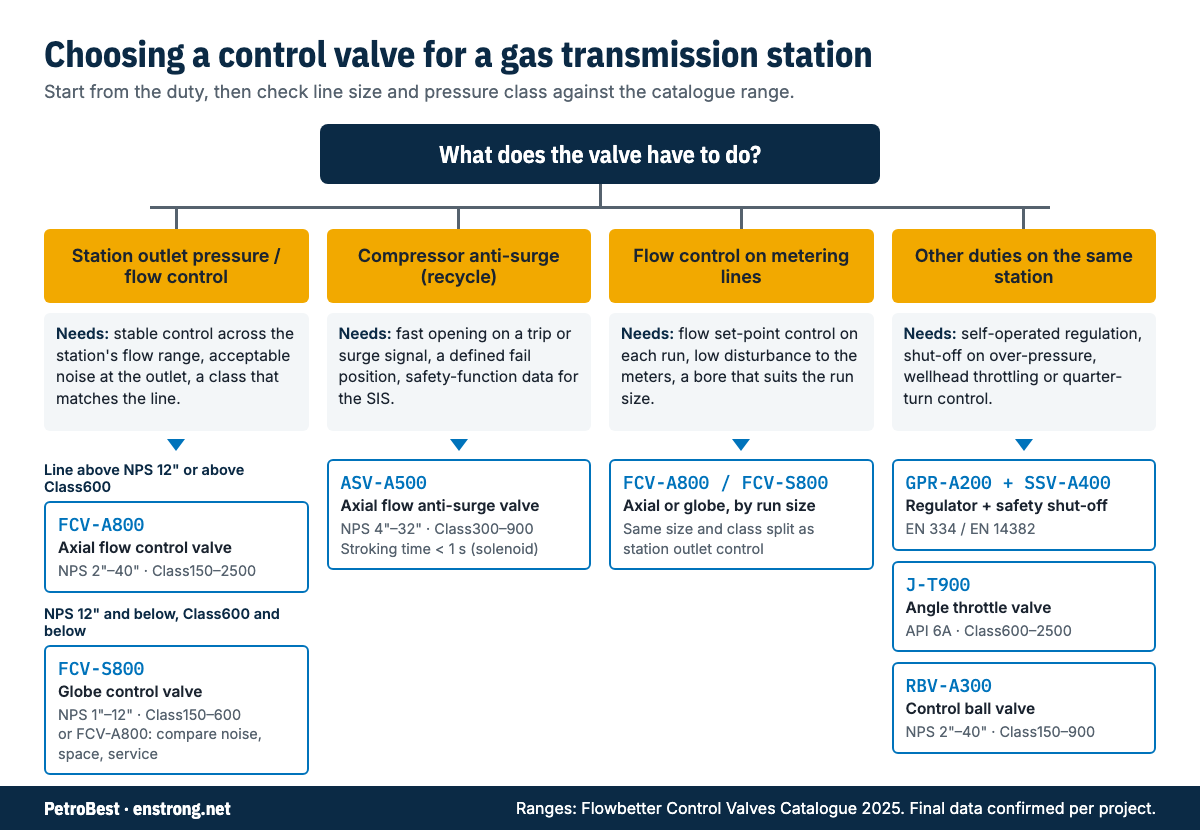
- Define the duty. Outlet pressure control, flow control on a meter run, anti-surge recycle, or self-operated regulation. Anti-surge goes to a dedicated valve such as the ASV-A500; self-operated regulation goes to a regulator train.
- List every operating case. Minimum, normal and maximum flow with inlet and outlet pressure for each, including start-up, low-demand and emergency cases. Size to IEC 60534-2-1 across all of them, not only the design point.
- Check size and class against the range. If the line is above NPS 12” or above Class600, the FCV-S800 is outside its catalogue range and the FCV-A800 applies. Below that, both are candidates.
- Set the noise limit at the pipe. Agree the allowable level and the measurement point, then compare predicted noise for both body types with the trims that fit.
- Consider what is downstream. Meter runs, short straight lengths and nearby instruments favour a valve that delivers an even outlet flow and low noise.
- Set the leakage class. Choose FCI 70-2 Class IV, V or VI from the process need, and check that the trim offered achieves it.
- Set speed and fail position. For anti-surge and emergency duties, specify opening time, fail action and the safety-function data your SIS needs.
- Plan maintenance. Ask how the trim is reached for the specific model and whether the valve has to come out of the line. Check the space around it for lifting.
- Check materials and temperature. Confirm body and trim materials against minimum design temperature; the catalogue lists -73 °C to +70 °C ambient, customisable.
What to send us for a sizing
A sizing request that can be answered in one pass includes the gas composition, all operating cases with flow and pressures, line size and class, the allowable noise, the required leakage class, actuator type and fail position, and the station layout around the valve. Catalogue pages and data sheets are on our downloads page.
Questions
What is the difference between an axial flow control valve and a globe control valve?
In an axial flow control valve the gas stays on the pipe axis and passes through an annulus around a streamlined inner body, with the plug stroking along the axis. In a globe control valve the gas turns through the seat and turns again to leave the body, and the plug strokes at 90 degrees to the pipe.
When should a gas station use a globe control valve instead of an axial flow valve?
A globe control valve suits smaller lines where the size and pressure class fall inside its range. The Flowbetter FCV-S800 covers NPS 1" to 12" and Class150 to Class600 in the 2025 catalogue. Above that, the FCV-A800 axial flow control valve covers NPS 2" to 40" and Class150 to Class2500.
What does an anti-surge valve need that a station control valve does not?
An anti-surge valve recycles gas around a compressor and must open quickly on a surge or trip signal, with a defined fail position. Stroking time depends on the actuator package and is confirmed per project. As shown in the PetroBest 2025 catalogue, it carries a SIL 2/3 (IEC 61508) certificate for DN100 to DN600, Class150 to Class900.
Which standards apply to control valves in gas transmission stations?
IEC 60534 covers industrial-process control valves, including sizing and noise prediction methods. FCI 70-2 defines seat leakage classes. The FCV-A800, FCV-S800 and ASV-A500 are listed to IEC 60534 with FCI 70-2 Class IV, V or VI seat leakage in the 2025 catalogue.
Can the same valve type be used for station outlet control and metering line control?
Yes. Both duties control flow or pressure with a positioned valve. The choice between axial and globe then follows the run size, pressure class, allowable noise near the meters and the station layout.
Sources
- Flowbetter Control Valves Catalogue 2025, p. 14 (FCV-A800)
- Flowbetter Control Valves Catalogue 2025, p. 19 (FCV-S800)
- Flowbetter Control Valves Catalogue 2025, p. 15 (ASV-A500)
- Flowbetter Control Valves Catalogue 2025, p. 13 (GPR-A200), p. 11 (SSV-A400), p. 24 (RBV-A300)
- Flowbetter Control Valves Catalogue 2025, pp. 29–32 (representative projects)
- PetroBest Group Profile 2026, p. 29 (DN800 Class600 control valves, Shenyang calibration station) and p. 33 (Zhongwei Station II, 2022)
- PetroBest Group Profile 2026, certificate wall (SIL 2/3 for ASV-A500, DN100–DN600, Class150–900)
- enstrong.net product pages: J-T900 angle throttle valve, Pressure Control System