
Water Bath Heater Guide: Heating Natural Gas Before Pressure Reduction
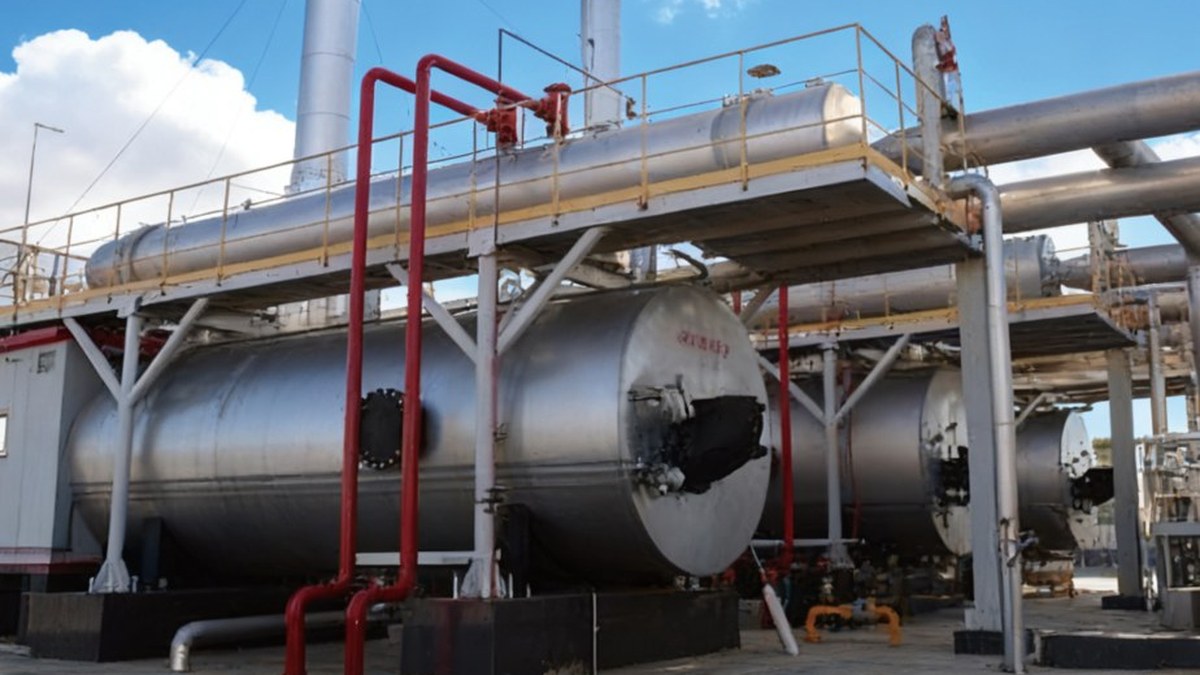
A water bath heater is an indirect-fired heater: a burner heats a bath of water at atmospheric pressure, and the water heats a coil that carries the natural gas or oil at line pressure. It is installed upstream of a choke or pressure regulator because gas cools as it expands, and without heat the outlet can drop to the point where hydrates, ice or liquids form. Water jacket heaters work on the same principle, while electric heaters do the same job with heating elements instead of a flame.
This guide explains where the cooling comes from, how the three heater types compare, and what information we need to size and quote one.
Why gas cools when pressure is reduced
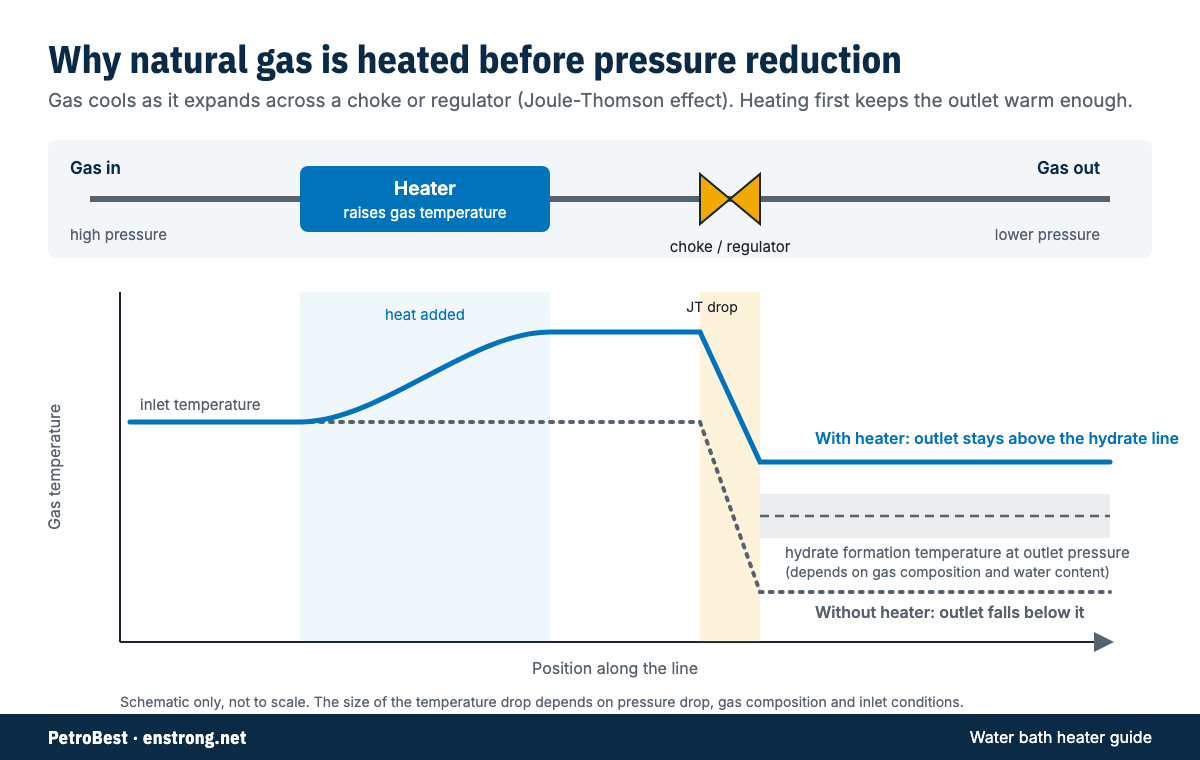
When a real gas expands through a restriction without doing work, such as a choke, a control valve or a pressure regulator, its temperature changes. For natural gas at pipeline and wellhead conditions the temperature falls. This is the Joule-Thomson (JT) effect.
A rule of thumb found in gas processing textbooks is roughly half a degree Celsius of cooling per bar of pressure drop (about 7 °F per 100 psi) for lean natural gas. Treat that only as an order of magnitude. The actual figure depends on gas composition, inlet pressure and inlet temperature, and it should be calculated with an equation of state for each case. What matters in practice is that large pressure drops, such as wellhead choking in a gas field or letdown from a transmission line to a distribution system, can bring the outlet temperature well below ambient.
What goes wrong when the outlet is too cold
Cold gas downstream of a pressure reduction point causes three types of problem.
Hydrates. Natural gas hydrates are ice-like solids formed from water and light hydrocarbons at low temperature and elevated pressure. They can form above 0 °C, so a line does not need to be freezing to plug. Hydrates collect in the regulator trim, in instrument lines and at bends, and can block flow or make regulation unstable. The hydrate formation temperature depends on gas composition, pressure and water content, so it is set by calculation or test for each gas, not by a single number.
Liquid dropout. If the gas cools below its hydrocarbon dew point, heavier components condense. Below the water dew point, free water appears. Liquids downstream of a regulator affect metering and filtration, and water feeds hydrate formation.
Cold equipment. Very low outlet temperatures can take piping, valve bodies and seals below their rated minimum temperature, and cause frost on the outside of the pipe. Regulator pilots are also affected: on our Flowbetter GPR-A200 and GPR-S200 pressure regulators an electric heater for the pilot is listed as an optional configuration in the Flowbetter valve catalogue for this reason.
There are three common ways to manage the problem: remove the water (dehydration), inject a hydrate inhibitor such as methanol or glycol, or heat the gas before it is let down. Many stations use more than one. Heating is often the simplest choice where the pressure drop is large and continuous, and where fuel gas or electric power is available on site.
Where gas heaters are used
In our equipment range, heating appears as a step in several process units:
- Gas field wellheads and gathering. The gas production unit integrates choking and pressure reduction, heating, separation, metering and safety protection in one system at the wellhead, as described in the PetroBest 2025 catalogue. Well streams leave the wellhead at high pressure with water present, so heating before the choke is a common requirement.
- Underground gas storage. During withdrawal, the gas from an underground gas storage injection and production unit is heated, choked, dehydrated, filtered and metered before it enters the pipeline.
- Pipeline stations and city gate stations. A pressure regulating system uses a safety shut-off valve, a monitor regulator and an active control valve in series. Where the pressure drop across that train is large, a heater is placed upstream of it.
- Fuel gas conditioning. The fuel gas treatment system that feeds gas compressors, gas generators and gas boilers integrates filtration, heating, metering and pressure regulation, with automatic control of the heating load.
How a water bath heater works
The water bath heater in the PetroBest 2025 catalogue is described as a process unit used in oilfields and natural gas stations to heat petroleum products and natural gas. It uses indirect heating. The water in the heater body is held at atmospheric pressure, and the coil carries the process medium, which can be oil products or natural gas. The main components are the heater body, the burner and the control system.
The arrangement has three consequences for design:
- Only the coil carries line pressure. The shell holds water at atmospheric pressure, so the high-pressure boundary is limited to the coil and its connections. The shell does not have to be designed for line pressure.
- The flame never touches the gas path. The burner fire tube heats the water, and the water heats the coil. There is no direct flame contact with the pressurised gas.
- The water bath evens out the heat. The bath acts as a thermal buffer between the burner and the coil, so the coil wall temperature stays close to the bath temperature and the outlet temperature is controlled by adjusting the burner.
Water jacket heaters
The water jacket heater works on the same principle. Water is heated by the burner flame and flue gas, and the hot water then heats the coil. The hot water in the heater body is at atmospheric pressure and open to the atmosphere, while the coil is at high pressure, usually 10 MPa according to the product page. It is built as single-well, multi-well, single-coil or multi-coil units, which suits wellsites and field stations where one heater serves several flow lines. The system includes the heater body, burner and control cabinet.
In practice “water bath heater”, “water jacket heater” and “indirect fired water bath heater” are often used for the same type of equipment. When you send an enquiry, the name matters less than the duty, the pressure and the number of coils.
Electric heaters for natural gas
An electric heater heats petroleum products, natural gas and other gaseous media, and is used in oil and gas surface processing and petrochemical plants. The unit consists of the heater core (heating elements), the heater shell and the control system. There are two configurations, described on the direct and indirect electric heater page:
- Direct electric heater. U-tube heating elements heat the medium directly. The unit consists of the heating core, a pressure-bearing shell and the control system. Because the gas is inside the shell, the shell is rated for line pressure.
- Indirect electric heater. The heating core first heats a heat-conducting (thermal) oil, which then heats the process medium. The system consists of the electric heating system, the thermal oil system and automatic control. The shell is atmospheric.
Electric heaters are used in oil and gas fields, petrochemical plants and on offshore platforms, including areas with explosive gas atmospheres. The heating system can be controlled automatically, including control from a DCS with safety protection functions. The trade-off against a fired heater is the power supply: an electric heater needs an electrical connection sized for the full heating duty.
Water bath vs water jacket vs electric heater
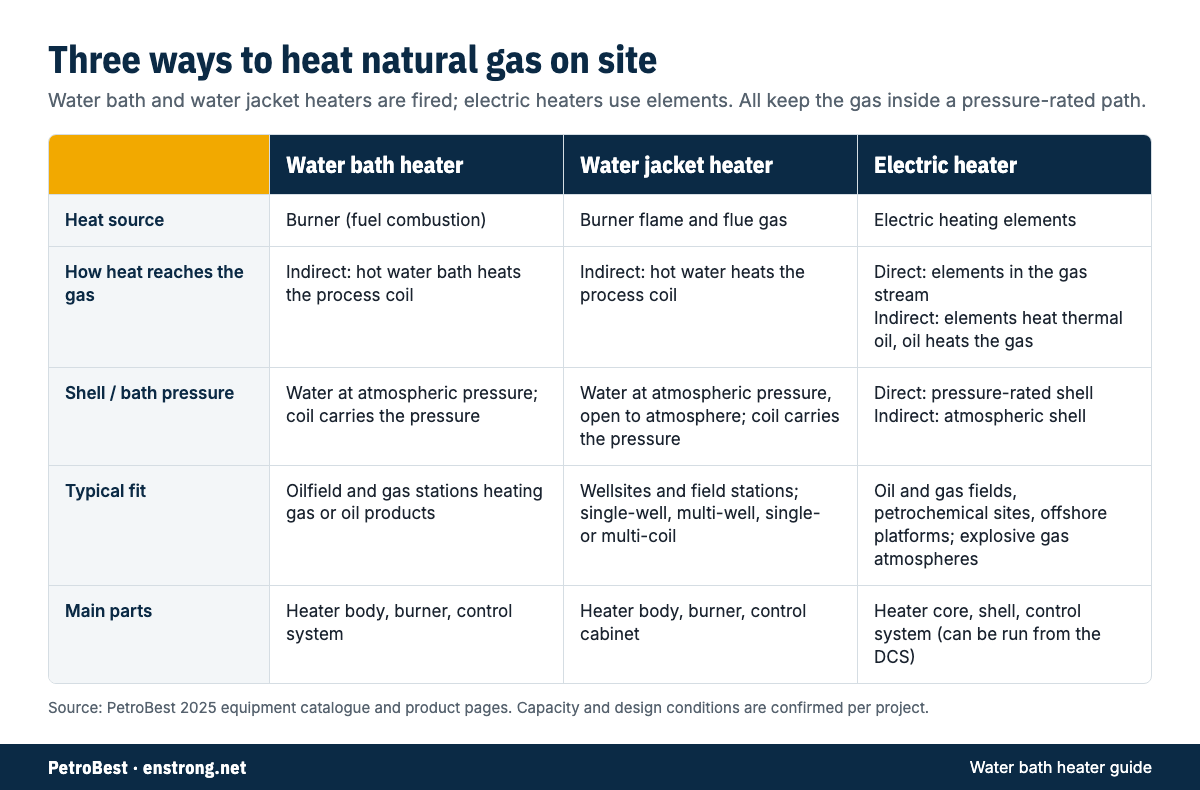
| Water bath heater | Water jacket heater | Electric heater | |
|---|---|---|---|
| Heat source | Burner, usually on fuel gas | Burner flame and flue gas | Electric heating elements |
| Heat transfer | Indirect: water bath heats the process coil | Indirect: hot water heats the process coil | Direct (elements in the gas) or indirect (via thermal oil) |
| Pressure boundary | Coil only; water at atmospheric pressure | Coil only; water at atmospheric pressure, open to atmosphere | Direct: pressure-rated shell. Indirect: atmospheric shell |
| Needs on site | Fuel gas, exhaust stack, burner management | Fuel gas, exhaust stack, burner management | Electrical supply sized for the full duty |
| Typical fit | Oilfield and gas stations, pipeline stations | Wellsites and field stations, single or multiple wells and coils | Sites with power, offshore platforms, areas where an open flame is not wanted |
| Main parts | Heater body, burner, control system | Heater body, burner, control cabinet | Heater core, shell, control system |
A short way to choose: if fuel gas is available and the duty is continuous, an indirect-fired water bath or water jacket heater is the usual answer. If power is available, the site cannot accept a flame, or space is tight, look at an electric heater. For small, intermittent duties, such as heating a regulator pilot, a small electric element is often enough.
Information needed to size and quote a heater
We size each heater from process data rather than a catalogue table. Sending the following with your enquiry avoids a round of questions:
- Gas composition (mol %), or at least specific gravity and water content. This sets the JT cooling and the hydrate formation temperature.
- Flow rate at minimum, normal and maximum conditions, in Nm³/h, Sm³/d or MMSCFD. Include expected changes over the field or station life.
- Inlet pressure and temperature at the heater, as a range. Wellhead conditions often change as a field declines.
- Outlet pressure after the choke or regulator, so the pressure drop can be calculated.
- Required outlet temperature after pressure reduction, or the hydrate and dew point margin your specification requires.
- Design pressure and design temperature for the coil, and the piping class of the connecting lines.
- Heat source available: fuel gas (composition and supply pressure) or electrical supply (voltage, frequency, available load).
- Number of streams: one well or several, one coil or several coils in one shell.
- Site conditions: minimum and maximum ambient temperature, altitude, indoor or outdoor, onshore or offshore.
- Hazardous area classification and any flameproof or explosion-proof requirements for the burner, control cabinet or heating elements.
- Control and interface: local control only, or signals to a PLC or DCS; outlet temperature control and shutdown requirements.
- Applicable codes and documents: the pressure vessel and piping codes the project requires, the inspection and certificate requirements, and any layout or skid size limits.
If some of these are not yet fixed, send what you have and mark the rest as open. We can work from a process flow diagram or a data sheet, and confirm capacity, design conditions and scope of supply per project. Our catalogues are on the downloads page.
Questions
What is a water bath heater used for?
A water bath heater warms natural gas or oil products in oilfields and gas stations. The process medium flows through a coil immersed in water; a burner heats the water, and the water heats the coil. It is most often placed upstream of a choke or pressure regulator so the gas stays warm enough after it expands.
Why does natural gas need heating before pressure reduction?
Gas cools as it expands across a choke or regulator (the Joule-Thomson effect). If the outlet temperature falls to the hydrate formation temperature, or below the hydrocarbon or water dew point, hydrates, ice or liquids can form in the valve and downstream piping. Heating the gas first keeps the outlet above those limits.
What is the difference between a water bath heater and a water jacket heater?
Both are indirect-fired heaters: a burner heats water held at atmospheric pressure, and the hot water heats a pressure-rated coil that carries the gas. The terms are often used for the same principle. In our range the water jacket heater is the field-station version, built as single-well, multi-well, single-coil or multi-coil units.
When is an electric heater a better choice than a fired heater?
An electric heater fits where reliable power is available, where an open flame is not wanted, or where space is limited, for example on offshore platforms or in areas classified for explosive gas atmospheres. It can heat the gas directly, with elements in a pressure-rated shell, or indirectly through a thermal oil loop.
What information is needed to size and quote a gas line heater?
At minimum: gas composition, minimum, normal and maximum flow, inlet pressure and temperature range, outlet pressure after the regulator, the required outlet temperature or hydrate margin, design pressure and temperature, the available heat source, site conditions and the hazardous area classification.
Sources
- PetroBest Equipment Catalogue 2025, p. 21 (Water Bath Heater, Electric Heater)
- PetroBest Equipment Catalogue 2025, p. 6 (Gas Production Unit), p. 7 (Underground Gas Storage Injection and Production Unit), p. 14 (Fuel Gas Treatment System)
- Flowbetter Control Valves Catalogue 2025, pp. 13, 18 (GPR-A200, GPR-S200 optional electric heater for pilot)
- PetroBest product pages: water-jacket-heater, direct-indirect-electric-heater, pressure-regulating-system